Summary:With the widespread use of infrared integrated cameras, fewer and fewer surveillance engineering technicians possess in-depth knowledge of the relationship between cameras and lenses, as well as the selection, matching, installation, and debugging of camera lenses. However, the lens is a crucial component of the surveillance front-end, and its compatibility with the camera determines the effectiveness of the front-end equipment. Although manufacturers of infrared integrated cameras have integrated lenses with cameras...
With the widespread adoption of integrated infrared cameras, fewer surveillance engineering technicians possess a deep understanding of the relationship between cameras and lenses—specifically regarding lens selection, compatibility, installation, and calibration. However, the lens is a crucial component of the surveillance front-end; its pairing with the camera determines the system's overall performance. Although manufacturers ship integrated infrared cameras with the lens pre-installed, having a clear understanding of lenses remains invaluable during on-site planning and budgeting. It enables more appropriate equipment selection and configuration, leading to superior results and minimizing the need for equipment swaps. Therefore, lens classification and selection constitute essential knowledge for surveillance engineering technicians.
I. Surveillance camera lenses can be broadly categorized based on application scenarios as follows:
(1) Wide-angle lens: Field of view (FOV) exceeds 90 degrees; typically used in locations requiring a wide view, such as elevator cabins and lobbies.
(2) Standard lens: FOV is approximately 30 degrees; typically used in areas such as corridors and residential complex perimeters.
(3) Telephoto lens: FOV is less than 20 degrees; focal lengths range from tens to over a hundred millimeters; used for long-distance surveillance.
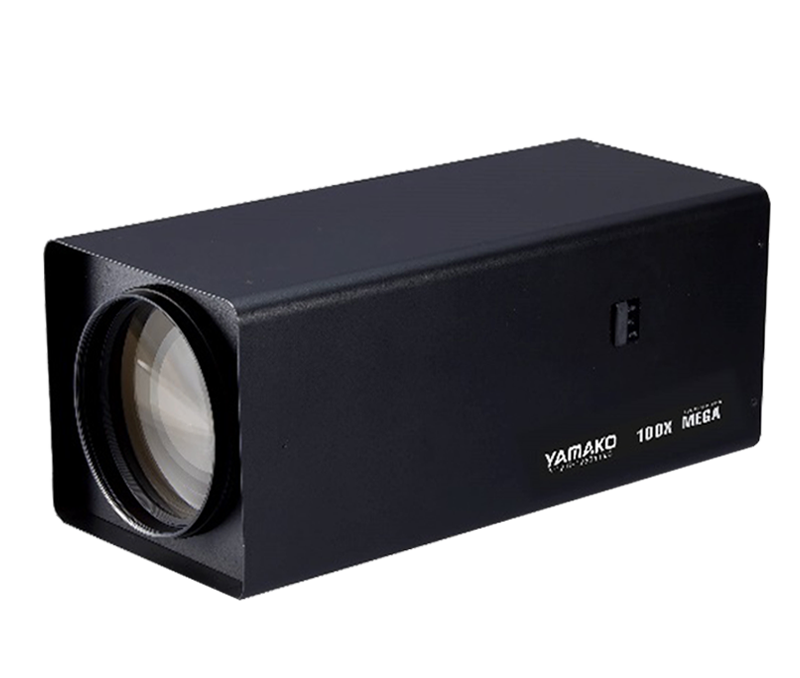
(4) Zoom lens: Variable focal length range, allowing adjustment from wide-angle to telephoto to cover a broad field of view.
(5) Pinhole lens: Used for covert surveillance.
II. Determining lens focal length: The following five factors determine the lens specifications during selection:
(1) Size of the surveillance area
(2) Size of the subject
(3) Object distance
(4) Focal length
(5) CCD sensor size. The standard focal length for the lens can be determined through on-site measurement and calculation based on the first four points mentioned above. The calculation methods are as follows: for a 1/3" CCD, F = 4.8 × L/W or F = 3.6 × L/H; for a 1/2" CCD, F = 6.4 × L/W or F = 4.8 × L/H. Here, W represents the width of the object being filmed, H is its height, L is the distance from the lens to the object, and F is the lens focal length.
The CCD chip acts like the human retina and is the core component of a surveillance camera. Currently, my country lacks the manufacturing capability for these chips; most surveillance cameras on the market use chips produced by companies such as Sony, Sharp, Panasonic, and LG (Japan). South Korea also has production capabilities, though the quality is slightly inferior. Variations in CCD image capture performance arise from factors such as the different quality grades produced during manufacturing and the varying sourcing channels used by different manufacturers.
When purchasing, you can test the camera using the following methods: connect the power and video cable to a monitor, then close the lens aperture. Observe whether any bright spots appear when the image is completely black and check the intensity of the "snow" (static noise) on the screen. These are the simplest and most direct ways to test a CCD chip without requiring specialized equipment. Next, open the aperture and view a still object—ideally one with vibrant colors if using a color camera—to check for color casts, distortion, and the smoothness of color or grayscale transitions. A high-quality CCD accurately reproduces scene colors, making objects appear clear and natural, whereas defective units may exhibit color casts (e.g., displaying blue or red hues even when pointed at a sheet of white paper). Due to dust in the production environment, some CCDs may have impurities on the target surface. While these impurities generally do not affect the image, tiny dust particles can cause issues in low-light or microscopic imaging applications; therefore, careful selection is essential if the camera is intended for such uses.
III. Classification by Imaging Color
Color surveillance cameras: Suitable for distinguishing fine details in a scene, such as the color of clothing or objects. Black-and-white surveillance cameras: Suitable for areas with insufficient lighting or locations where installing lighting equipment is not feasible; black-and-white cameras are a suitable choice when the primary goal is simply to monitor the scene or detect movement.
IV. Classification by resolution, sensitivity, etc.
Standard models feature an image resolution of under 380,000 pixels; among these, models with 250,000 pixels (512 x 492) and a resolution of 400 TV lines are the most common.
High-resolution models feature an image resolution exceeding 380,000 pixels.
V. Classification by CCD sensor size
When selecting a lens, keep this principle in mind: a CCD camera with a smaller sensor size can use a lens designed for a larger sensor size, but the reverse is not true. The reason is that if a 1/2-inch CCD camera uses a 1/3-inch lens, light intake decreases, color quality deteriorates, and the image may even be incomplete; conversely, using a larger-format lens results in increased light intake and improved color and image quality. To achieve the same field of view with a 1/3" CCD camera as with a 1/2" CCD camera, the focal length of the lens must be reduced. Conversely, what happens if the same focal length lens is used on both? The field of view of the 1/3" CCD camera will be significantly narrower than that of the 1/2" CCD camera; additionally, the image from the 1/3" CCD camera will appear magnified on the monitor compared to the 1/2" CCD image, creating an effect similar to using a telephoto lens.
Naturally, considering all factors, it is best to select a lens that is properly matched to the camera.
CCD chips have been developed in various sizes:
Currently, the most commonly used chips are 1/3" and 1/4". When purchasing surveillance cameras—especially when there are strict requirements regarding the viewing angle—the size of the CCD sensor (target area) and the compatibility between the CCD and the lens will directly affect the field of view and image clarity.
1-inch: Sensor dimensions are 12.7mm (W) x 9.6mm (H); diagonal 16mm.
2/3-inch: Sensor dimensions are 8.8mm (W) x 6.6mm (H); diagonal 11mm.
1/2-inch: Sensor dimensions are 6.4mm (W) x 4.8mm (H); diagonal 8mm.
1/3-inch: Sensor dimensions are 4.8mm (W) x 3.6mm (H); diagonal 6mm.
1/4-inch: Sensor dimensions are 3.2mm (W) x 2.4mm (H); diagonal 4mm.
VI. Classification by Scanning Standard
PAL system; NTSC system. China uses the interlaced scanning PAL system (CCIR for black-and-white), with standards of 625 lines and 50 fields; non-standard systems are used only in medical or other specialized fields. In contrast, Japan uses the NTSC system, with 525 lines and 60 fields (EIA for black-and-white).
VII. Classification by Power Supply: 110VAC (most NTSC systems fall into this category), 220VAC, 24VAC, 12VDC, or 9VDC (miniature surveillance cameras often fall into this category).
VIII. Classification by synchronization method
Internal synchronization: Operation is driven by synchronization signals generated by the camera's internal circuitry.
External synchronization: An external synchronization signal generator is used to feed the sync signal into the camera's external sync input port.
Power synchronization (Line Lock): Vertical drive synchronization is achieved using the camera's AC power supply.
External VD synchronization: External VD synchronization is achieved by inputting VD (Vertical Drive) sync pulses via the camera's signal cable.
External synchronization for multiple cameras: Fixed external synchronization is applied to multiple cameras so that each operates under identical conditions; because the cameras are synchronized, the image remains undistorted even if one camera switches to a different scene.
IX. Classification by illumination level (CCD surveillance cameras):
Standard type: Requires 1–3 lux for normal operation.
Moonlight type: Requires approximately 0.1 lux for normal operation.
Starlight type: Requires less than 0.01 lux for normal operation.
Infrared type: Uses infrared illumination to capture images even in the absence of visible light.
X. Classification by iris type (surveillance camera lenses): Manual iris and auto-iris
The choice between manual and auto-iris lenses depends on whether the ambient illumination is constant. Manual iris lenses are suitable for environments with constant lighting—such as elevator cabins, enclosed corridors, or rooms without direct sunlight—as the aperture can be set once during initial system installation and calibration based on actual lighting conditions to achieve satisfactory image brightness. Auto-iris lenses are required for environments with frequently changing illumination—such as entrance halls, areas near windows, and lobbies where lighting varies significantly with daylight—(requiring a camera equipped with an auto-iris lens socket); this enables automatic adjustment of image brightness, ensuring a high-quality image with relatively consistent brightness. Auto-iris lenses are further categorized into DC-drive and Video-drive types based on the control signal used. There are two control methods: DC voltage control and video signal control. Proper coordination is required among three factors: the selection of the auto-iris lens type, the connection method at the camera's auto-iris lens port, and the setting of the drive mode switch.
XI. Classification by surveillance camera shape
Bullet cameras, dome cameras, HD smart PTZ (dome) cameras, pen-style cameras, board cameras, UFO-style cameras, key-style cameras, mobile phone-style cameras, etc.


 ServiceService support
 Hot Products
 Solution
 Contact information